Last updated November 18, 2026


Free written scope consultation - allowances, timeline, and change-order rules on paper before a single trade is scheduled
Bathroom Remodeling Warning Signs Every Homeowner Should Know
The contractor who lowballed your bathroom bid by $8,000 didn’t find a better way to do the work – he found a way to start the job and renegotiate once your walls are open. That’s the uncomfortable truth about how bathroom remodels go wrong. The damage rarely starts with a bad tile set. It starts weeks earlier, in a bid that’s missing a line item, an allowance that says “per owner’s selection,” a payment schedule that wants 50% at signing. This guide walks you through the signals that show up before a single tile is pulled: what a shaky bid looks like, what a bad job site looks like, and what contract language should make you walk. We’ve watched these patterns play out across Berkeley bathrooms, from the pre-war flats near the Elmwood to the newer condos along Fourth Street.
Quick Answer
The biggest bathroom remodeling warning signs are vague or missing line items in the bid, allowances instead of real prices, no written waterproofing detail, a payment schedule that front-loads deposits, an unwillingness to pull permits, and a contractor who won’t answer a straight question before the job starts. If you see two or more of these, slow down. In our experience, the contract and the bid reveal what the finished job will look like long before demolition day.
Styles & brands we work with
- Kitchen remodeling
- Bathroom remodeling
- Home additions & ADU
- Roofing
- Windows & doors
- Driveway & pavers
- Fence
Table of Contents
- Bid Red Flags That Predict Trouble
- The Waterproofing Silence
- On-Site Warning Signs During Construction
- Contract Language Traps
- How to Verify a Contractor in California
- The Permit Check Step by Step
- Warning Signs in Finished Work
- Berkeley-Specific Red Flags
Bid Red Flags That Predict Trouble
A bid is the first piece of finished work a contractor shows you. If it’s sloppy, rushed, or missing scope, the job will follow. The bathroom remodels we see go sideways in Berkeley almost always start with a bid that was priced in an hour and never revisited. Here’s what to look for in the document before you sign anything.
Missing line items. A real bathroom bid has separate lines for demolition and haul-away, rough plumbing, rough electrical, framing repair, cement board or foam backer, waterproofing membrane, tile labor and setting materials, grout and sealant, finish plumbing trim, vanity and fixture installation, paint, and final cleanup. If those lines aren’t listed, they’re either included in a mystery lump number or not included at all. Both are a problem.
Allowances instead of prices. An allowance is a placeholder dollar figure for something the contractor hasn’t priced yet – typically tile, fixtures, or a vanity. A $2,500 tile allowance means you’re on the hook for every dollar the actual tile runs over. On a bathroom where you fall in love with a $32-per-square-foot tile instead of the $6-per-square-foot the contractor assumed, that allowance can blow up your budget by thousands. Ask for an itemized list of every allowance and a realistic range for each. If the contractor can’t give you one, they haven’t thought the job through.
No waterproofing callout. We’ll get into this in the next section, but it bears mentioning here. If waterproofing isn’t named in the bid as a separate scope item, assume it’s being treated as an afterthought. On a shower wall, that assumption is dangerous. Water is patient. It will find the seam.
A “labor only” or “materials by owner” bid. Sometimes this is legitimate. Often it’s the contractor shifting supply chain risk onto you, then blaming you when the tile is back-ordered, the faucet is the wrong rough-in size, or the substrate doesn’t match the plan. If you go this route, get every material spec in writing.
- Does the bid itemize demo, plumbing, electrical, and drywall separately, or hide them in a lump sum?
- Are tile, fixtures, and vanity priced, or listed as allowances with no ranges?
- Is waterproofing named as a separate line item?
- Is a permit called out explicitly, including who pulls it and who pays for it?
- Does the bid state a demolition scope precisely, or leave “hidden conditions” as an open-ended excuse?
A strong bid says what the contractor does and doesn’t do, and it prices both. A weak one leaves the boundaries fuzzy so the contractor can widen the scope later. If you’re comparing a full-scope bathroom bid against a vague one, the vague one is usually cheaper on paper and more expensive in practice. Compare bids against a real bathroom remodeling scope to see what’s missing. And if the contractor won’t answer a straight question about line items before the job starts, ask why.
The Waterproofing Silence
Ask ten Berkeley contractors how they waterproof a shower and you’ll get four or five different answers. The problem isn’t that there are options. It’s that the answer reveals whether the contractor has thought through water control or is just going to hang cement board and hope. Water damage is the most expensive and slowest-to-show failure in residential construction. It usually hides for two to five years before you see a stain on a ceiling below. If waterproofing gets skipped or half-done, the first failure sign is usually the shower pan leaking into the structural subfloor.
Here’s how a shower should be waterproofed, at a minimum:
- Sloped mortar bed under the pan, with slope toward the drain of at least 1/4 inch per foot (the code minimum in California), so water flows toward the drain rather than sitting in the pan.
- A waterproofing membrane – either a liquid-applied membrane or a bonded sheet membrane – applied to the shower pan and up the walls at least to the showerhead height.
- Reinforcing fabric at every inside corner and seam where substrate panels meet.
- Cement backer board or a foam backer panel, not greenboard drywall, behind tile.
- A flood test on the pan before tile goes down. A flood test fills the pan with water and lets it sit 24 to 48 hours to see if any water escapes. Good contractors do it and invite the homeowner to see the results.
If your contractor can’t describe their waterproofing method in two or three sentences, that’s a red flag. If they tell you “we’ve never had a leak,” ask how many showers they’ve done and how long ago. In our experience, shower leaks show up in year three to six. A contractor who has only been doing showers for two years hasn’t seen the failures yet.
Berkeley’s housing stock makes this especially important. The pre-1950 bathrooms in North Berkeley and the Elmwood often have original cast iron drains and un-ventilated plumbing walls that were never designed for modern shower systems. That doesn’t mean they can’t be renovated well – it means the waterproofing detail requires more thought, not less.
On-Site Warning Signs During Construction
The job site is a live document. Every morning you walk through, you’re reading what the contractor values. We’ve walked into Berkeley remodels where the subfloor was left exposed overnight, the toilet drain was open to soil gas, and the tile guy was setting over fresh backer board the same day it went up. All three of those are warning signs you don’t need to be a builder to spot.
Covered subfloor overnight. When the toilet and floor tile are removed, the open subfloor and drain line should be covered or plugged at the end of every workday. An uncovered subfloor is a debris and water source and an open drain line lets sewer gas back into the house. This is basic job site hygiene, and a crew that skips it is telling you something about how they think.
No visible moisture barrier. In a wet-area remodel, you should be able to see the waterproofing go in before the tile goes on. Ask your contractor to walk you through the membrane installation before they cover it. Any contractor who’s proud of their waterproofing will welcome the walkthrough. One who’s not will get cagey.
Tile set before substrate is cured. Thinset and backer board have a cure window. Setting tile the same day, or within a few hours, is a shortcut. The failure shows up as loose tile, cracked grout, or hollow-sounding tile underfoot, often within a year. If you tap a finished floor and hear hollow spots, that’s the sound of a shortcut.
Unventilated curing in a sealed bathroom. Portland cement and many thinsets release moisture as they cure. Curing agents need airflow. A crew that wet-seals the room to speed dry time is trading quality for speed.
No dust control. A real crew uses poly sheeting and negative air pressure or a HEPA vacuum to control dust, especially on pre-1950 Berkeley bathrooms where old paint and insulation can carry lead or asbestos. If you see dust pouring out of the bathroom door into the rest of the house, the crew skipped a step.
No debris schedule. A job site that accumulates demo debris for days is a job site that’s being managed casually. Daily or every-other-day debris removal is standard. Ask in advance what the debris plan is. Reasonable answers exist. “We’ll get to it” is not one.
Contract Language Traps
Read the contract twice. Read the payment schedule three times. In our experience, the most expensive clauses in a bathroom rebuild aren’t the ones about tile or fixtures – they’re about change orders and money flow.
Change order clauses
A change order is a modification to the agreed scope. Change orders are normal. What’s not normal is a contract that allows the contractor to issue change orders without your signature, or one that lets “hidden conditions” or “unforeseen scope” be billed without a fixed price. In Berkeley bathrooms, hidden conditions are almost guaranteed – old cast iron drain lines, knob-and-tube wiring behind a wall, settling from the 1906 quake or the 1989 Loma Prieta. What matters is how those conditions get priced. A good contract says: if hidden conditions come up, work stops, you get a written fixed-price change order, and you approve before the contractor proceeds. A bad contract says: hidden conditions will be billed at time and materials as they arise. That’s the difference between a $22,000 bathroom and a $41,000 bathroom.
Payment schedule traps
California has a specific rule on this and it’s worth knowing. Under the California Business and Professions Code, a home improvement contract can’t require more than 10% of the contract amount, or $1,000, whichever is less, as a down payment. That’s a legal cap on front-loaded deposits. If a contractor asks for 30% down on a $25,000 bathroom, that’s $7,500 – well above the legal cap. The proper schedule is 10% or $1,000 at signing, then payments tied to progress milestones (demo complete, rough-in complete, tile complete, final walkthrough), with a final payment held back until you’re satisfied. If the schedule tells you otherwise, that’s a legal warning sign, not just a style preference.
Other clauses to watch
- “Time and materials” with no cap. A time and materials contract with no maximum is a blank check. If the contractor insists on T&M, negotiate a not-to-exceed number.
- Warranty fine print. Look for the warranty duration, what’s excluded, and whether it transfers if you sell the home. A 730-day workmanship guarantee means the contractor stands behind their labor for two full years. Short warranties – 30 or 90 days – tell you something about what the contractor expects will fail.
- Arbitration clauses with fee-shifting. Some contracts push all disputes into private arbitration and make you pay the contractor’s legal fees if you lose. That’s not illegal in California if it’s fair, but read it before you sign.
- Lien waiver language. If the contractor bids but plans to subcontract out most of the work, ask how they’ll handle mechanic’s liens from unpaid subs. A good contract has a written lien waiver clause.
When the contract reads like a trap, walk. You don’t owe anyone a signature on a 90-minute sales pitch. A real contractor will hand you the contract, tell you to take it home, and answer questions the next week. If a contractor is pressuring you to sign today, that pressure is a signal. Ours reads clean and direct, and we’ll walk you through every clause before you sign.
How to Verify a Contractor in California
You don’t have to take a contractor’s word for anything in California. The state gives you one of the most transparent contractor verification systems in the country. Here’s the exact process, not the general advice.
- Check the license. Go to cslb.ca.gov, the Contractors State License Board. Look up the contractor’s license number and confirm the license is active, not suspended or revoked. A bathroom remodel over $500 in labor and materials requires a licensed contractor in California. The license should be a General Building Contractor (B) or a general engineering license, or a specialty license appropriate to the scope. For a bathroom remodel, a B license is standard.
- Verify the bond. The CSLB record shows whether the contractor’s bond is current. Every licensed contractor has to carry a $25,000 contractor’s bond. If the CSLB record shows the bond expired or was cancelled, that’s a hard no.
- Ask for the insurance certificate. Don’t take a verbal assurance. Ask for a current certificate of general liability insurance and a certificate of workers’ compensation insurance. Call the insurance company directly using the phone number on the certificate to confirm the policy is active and the named insured matches the contracting company name. A certificate can be fabricated. A phone call to the carrier can’t.
- Check for complaints and citations. The CSLB site lets you view complaint history and citations. A single complaint isn’t necessarily fatal. A pattern of complaints, or citations for unlicensed activity or abandoned jobs, is a warning sign.
- Confirm the contractor’s business address matches what’s on the contract. A mismatch between the address on the CSLB record and the address the contractor gives you is a reason to ask more questions.
Berkeley homeowners have access to the Alameda County District Attorney’s consumer protection division for broader complaint history, and the Better Business Bureau shows complaint patterns over time. Checking all of these takes 20 minutes and can save you a $30,000 mistake.
One more: ask the contractor to sign and give you a written statement of the license number and insurance coverage as part of the contract package. A contractor who won’t put their own license number in writing is showing you a warning sign before you’ve even signed.
The Permit Check Step by Step
A bathroom remodel that involves moving plumbing, moving electrical, or replacing a shower pan almost always requires a permit in Berkeley. A simple tile-and-fixture replacement may not. A contractor who tells you “we don’t need a permit for this” is a warning sign, and asking them to walk you through their reasoning is a fast and useful test. Ask them what triggers a permit, what the permit covers, and who pulls it.
The Berkeley permitting process is run through the city’s Planning and Development Department and Permit Service Center. Here’s the exact check:
- Ask the contractor which permit they’ll pull. A bathroom remodel that involves moving plumbing or electrical needs both a building permit and either a plumbing or electrical sub-permit. Tile-only replacements may not need one. Have the contractor name the permits.
- Ask for the permit number once the job is permitted. The permit number is public. Search for it on Berkeley’s online permit portal to confirm the permit is real, is for the correct address, and matches the described scope.
- Ask for the inspection schedule. A permitted bathroom remodel gets inspected at rough framing, rough plumbing, rough electrical, and tile substrate before final. Ask the contractor what inspections they’ll schedule and when. A contractor who’s running a clean job will have that schedule worked out before demo.
- Confirm the final permit is signed off before the final payment. A final sign-off is the city’s version of a completion certificate. Never release the final payment until it’s in hand and confirmed.
Berkeley has its own permitting rhythms. The city’s ADU and addition work often gets bundled into a single permit, but bathroom remodels are usually a simpler, faster permit. In our experience, the permit turnaround for a straightforward bathroom remodel in Berkeley is generally a matter of weeks, not months, and the contractor should have a realistic expectation for it before you sign. If the answer is “we might not need a permit, we’ll just do the work,” that’s not a shortcut – that’s a decision that can bite you at resale or with the city.
If you want a single point of accountability for permit, inspection, and build, our full-scope home additions and ADU services cover exactly that kind of paperwork-heavy scope. The same discipline applies to a bathroom remodel.
Warning Signs in Finished Work
Water damage is patient. If waterproofing was skipped or the drain was not properly sloped, the visible failure – a stain on the ceiling below, a soft spot in the subfloor, a smell – may not show up for two to five years. That’s why you read the finished work carefully on day one, before the failure has a chance to hide.
Here’s what to check in the first 90 days:
- Sound test on floor tile. Tap with the handle of a screwdriver across every floor tile. Hollow spots mean thinset voids, which mean the tile will come loose. Every tile should sound the same – a solid, dull thud, not a hollow click.
- Check the shower pan at the corners. Run a shower for 15 minutes, then look at the ceiling below the shower and at the base of the shower on the outside. Any moisture, any discoloration, any damp smell, and you have a waterproofing failure. Address it before year three or it’s a full redo.
- Test the toilet flange. A toilet that rocks, or that leaks at the base, usually means the flange wasn’t properly secured. Grab the bowl and rock it gently. A well-set toilet is rock solid.
- Check door clearances. A bathroom door that drags on the floor, or that won’t close cleanly, is often the result of new floor tile installed at a different height than the contractor estimated. Small issue, easy to call out now, harder to fix once you’ve settled in.
- Look at grout lines. Uneven grout lines are the signature of a rushed tile set. Look for grout joints that run wide on one end and tight on the other, or grout color that varies across the room.
- Check caulking at the tub and shower edges. A good caulk line is continuous, smooth, and touches both surfaces. If the caulk is already cracking at the first spring, that’s a shortcut showing itself early.
- Water test every drain and supply. Run every drain (sink, shower, tub) and check under every cabinet for a day or two after the final walkthrough. A slow drip under the sink that starts a week after the contractor leaves is a serious problem.
If you find any of these, document them in writing and contact the contractor. If they have a strong warranty, they’ll fix it. If they don’t, you’ll learn something about the warranty’s real value the moment you need it.
Berkeley-Specific Red Flags
Berkeley has a specific contractor market and specific construction realities. Red flags that might be mild elsewhere are serious here.
No awareness of pre-1950s construction. Large parts of central and North Berkeley, the Elmwood, and the neighborhoods near the UC campus were built before 1950. Those bathrooms often have original cast iron drain lines, unventilated plumbing walls, and sometimes knob-and-tube wiring hiding in the walls. A contractor who doesn’t ask about the age of the building or doesn’t seem to care is a warning sign. Real builders know that pre-war Berkeley bathrooms require more discovery than a newer condo.
No mention of seismic or moisture context. Berkeley sits in a seismically active zone, and the Bay Area’s winter moisture is real. Bathroom drain lines and anchors need to account for movement; exterior walls need proper moisture blocking. A contractor who shrugs off the seismic and moisture detail is showing you they’re not thinking about the building as a system.
“Expired” permit rollover. If a previous owner opened a bathroom permit and never closed it, the contractor needs to deal with it before pulling a new one. A contractor who skips that step is setting the homeowner up for a permit problem down the line. Ask: “Is there an open permit on this property already?” A good contractor will check first.
No Berkeley references at all. Ask a simple question: “What’s the spray-foam code in Berkeley for wet areas?” or “How does the Berkeley permit office usually handle a bathroom with an original cast iron drain?” If the answer is a blank stare and a redirect, that’s a signal. Berkeley has specific procedures, and a contractor who hasn’t had to work with them before will slow down your job.
No material brand confidence. Real contractors can tell you why they specify one waterproofing product over another, or how they choose backer board. If a contractor can’t name a single product they use, they’re not making choices – they’re just ordering whatever is cheapest that week. Our brand partners carry confidence. When you see Quikrete or Sakrete in the spec, you’re looking at materials someone chose.
Common Mistakes to Avoid
- Hiring on price alone. The lowest bid is often the bid that hasn’t priced everything. On a Berkeley bathroom remodel with a pre-war drain system, an under-priced bid almost always gets renegotiated once the walls come down. Price high enough to cover the real scope, then push for line-item transparency.
- Not calling the CSLB before signing. The state database is free and takes five minutes. Skipping it because the contractor “seems trustworthy” is how homeowners get burned. Check first.
- Accepting an allowance with no realistic range. A $2,500 tile allowance in a Berkeley bathroom is not realistic if you want a real tile floor. Ask for actual pricing on the tile you plan to use before the bid is final.
- Paying more than the California down payment cap. The law limits down payments to 10% or $1,000, whichever is less. If a contractor asks for more than that at signing, they’re asking you to violate the state cap untested waters and put your money at risk.
- Letting the contractor pull the permit without checking it. A permit number can be invented. Look it up. Confirm the address and scope match.
- Ignoring a weak warranty. A 90-day warranty is a signal. Ask why the contractor is so confident the work will only last 90 days. Our 730-Day Done Right Promise exists for the opposite reason – because we expect our work to outlast the warranty period, not barely reach it.
- Skipping the waterproofing walkthrough. Ask to see the membrane go in before the tile goes on. Any contractor who gets defensive about the walkthrough is a contractor who isn’t proud of what’s under the tile.
Each of these mistakes is cheap to avoid now and expensive to fix later. A Berkeley bathroom, done right, lasts 20 years or more. Done wrong, the first failure starts showing up in year two or three and the second one in year five.
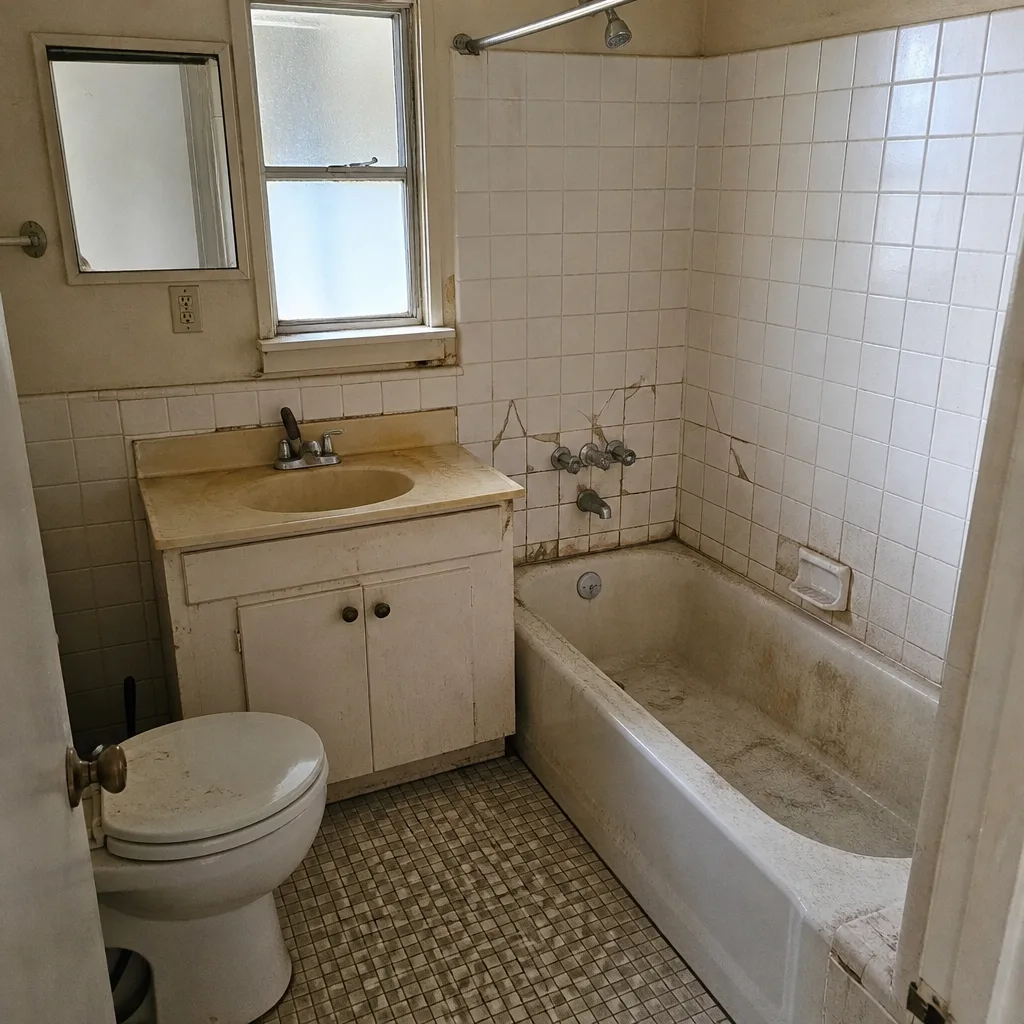
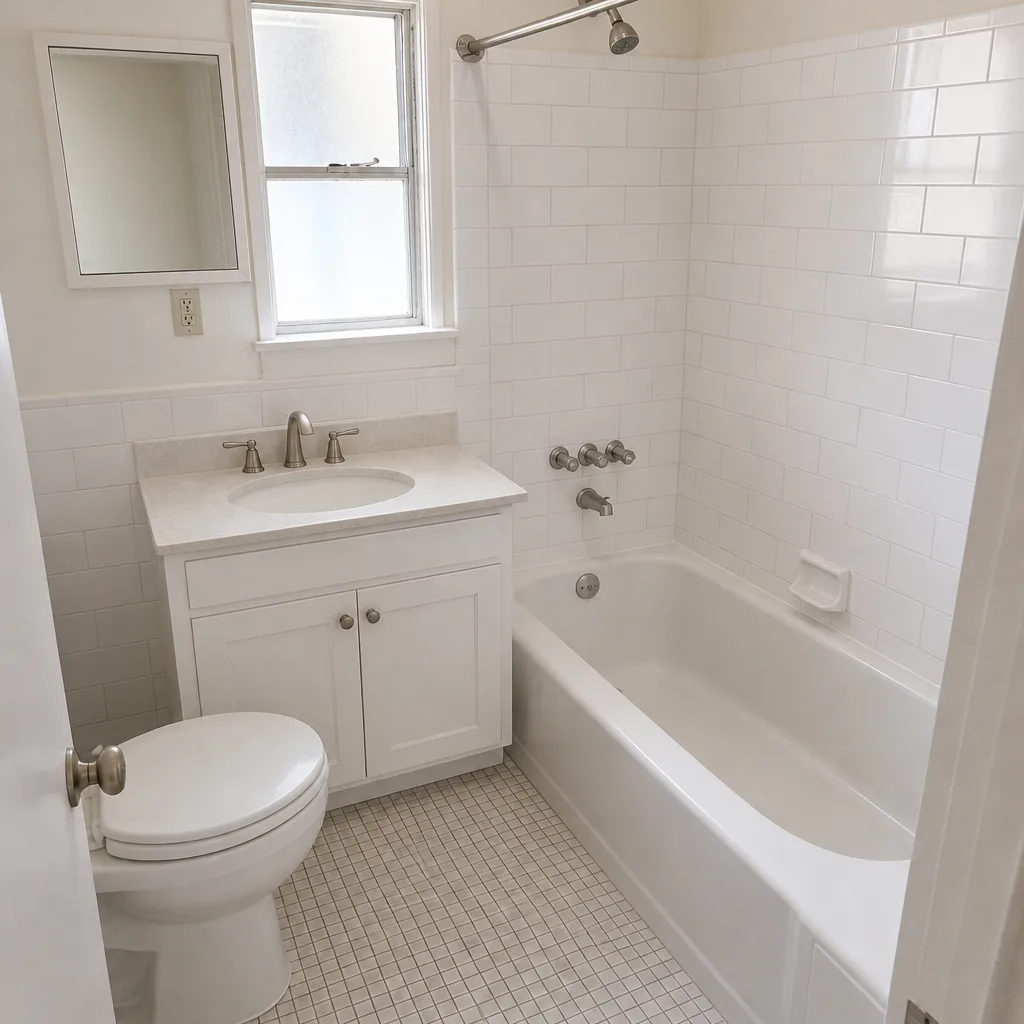
See the difference
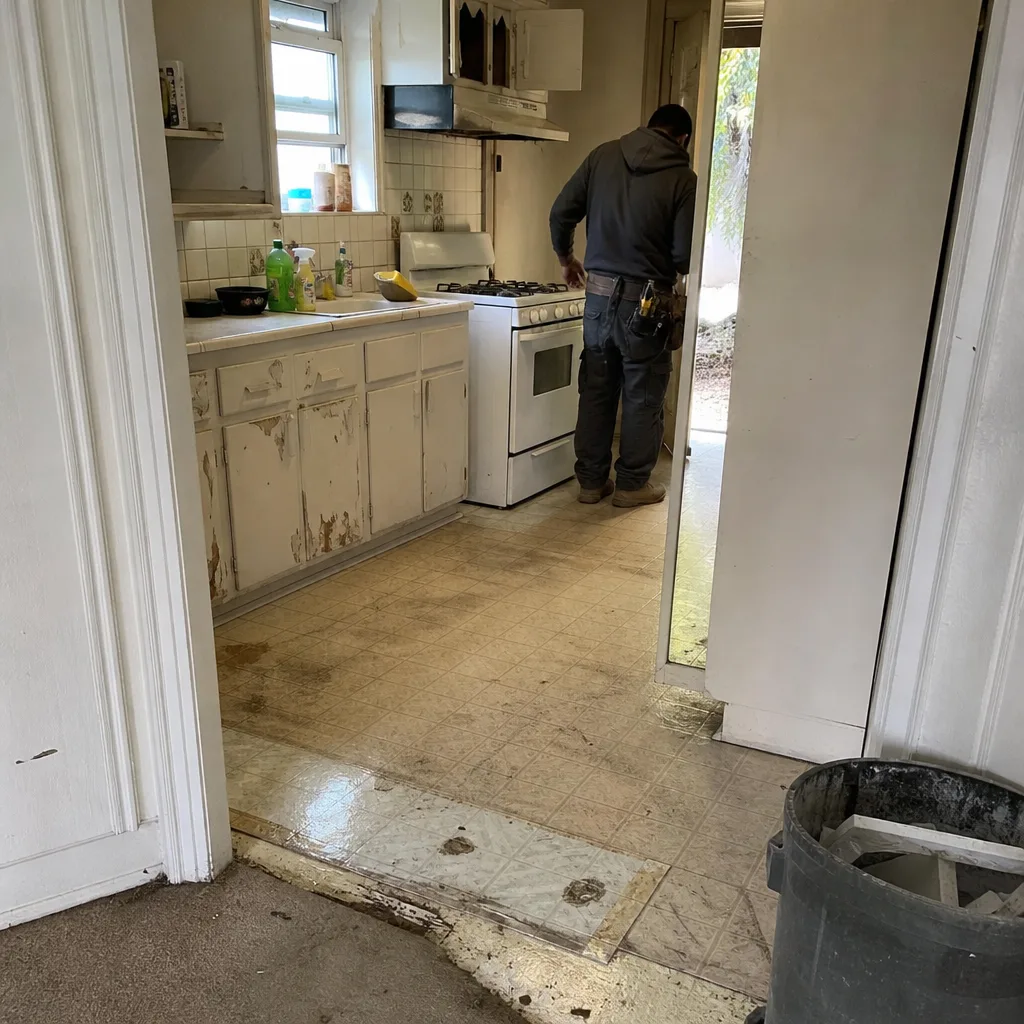 Before
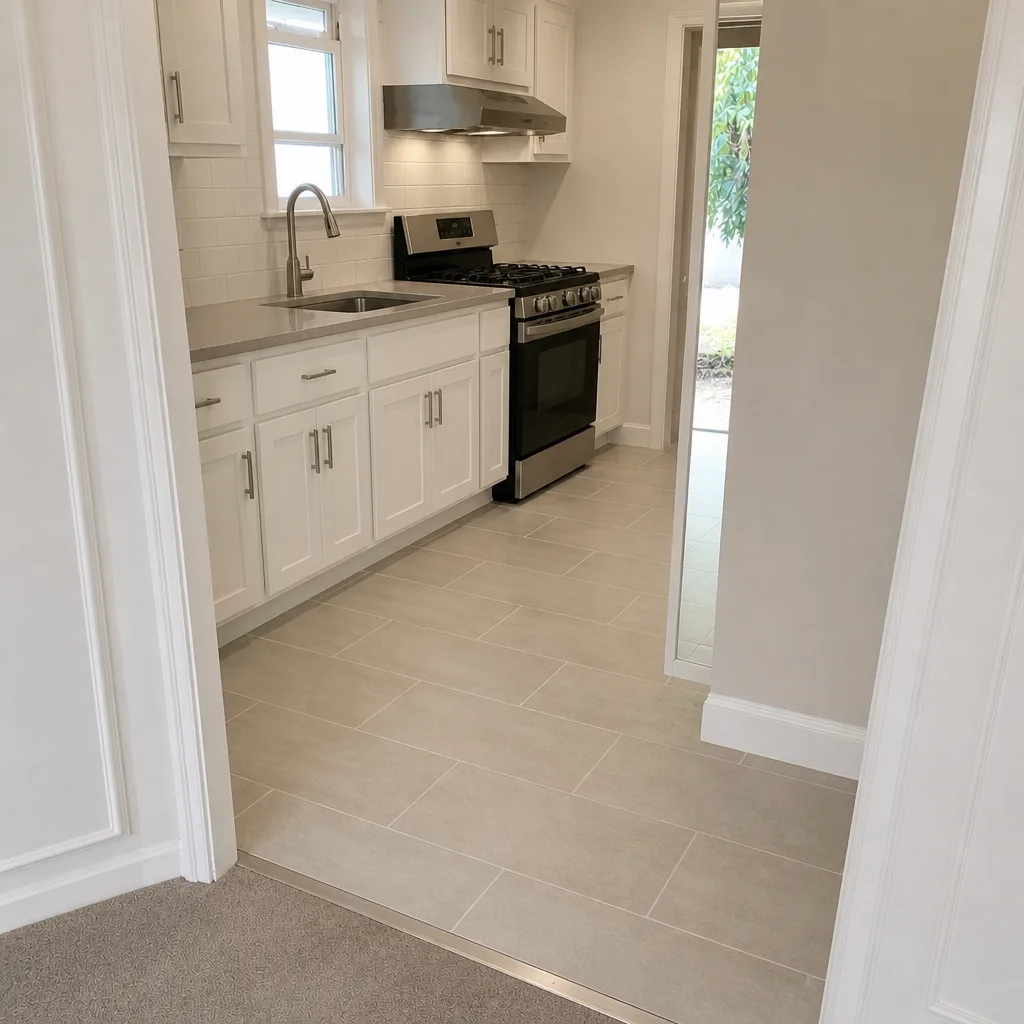 After
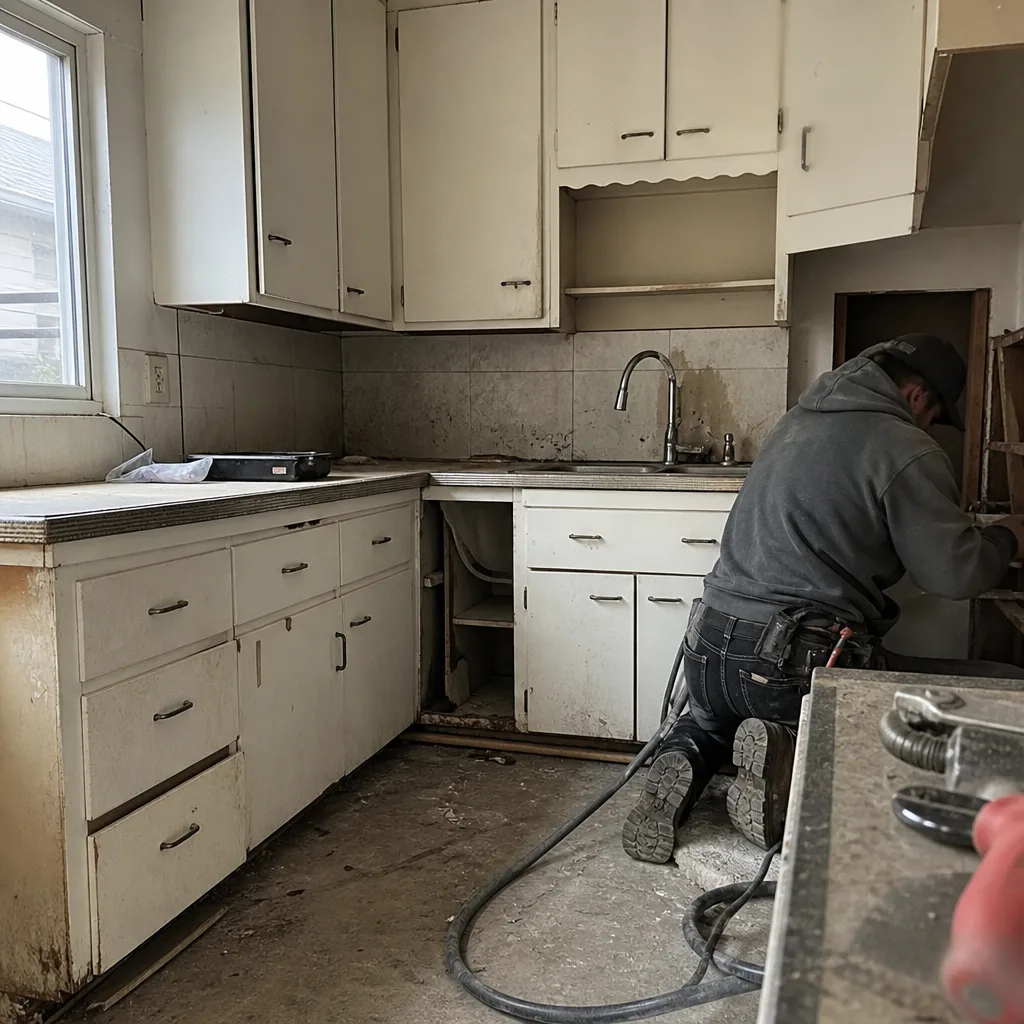 Before
 After
 Before
 After
When to Call a Professional
Some bathroom work can be done by a competent homeowner. Most can’t. Waterproofing a shower, moving a drain, running electrical in a wet area, and pulling a permit in a pre-war Berkeley building are not homeowner-scale jobs. Here’s when to call in a professional rather than keep pushing through:
- You’re moving any plumbing or electrical. Drywall removal reveals a cast iron drain that needs replacing, or a wire that has to move. That’s a licensed trade call, not a DIY call.
- You’re replacing a shower pan. Pan waterproofing is where most failures start. It’s a step that should be done by someone who’s done hundreds of them.
- You’re remodeling a bathroom in a pre-1950s Berkeley building. Hidden conditions are almost guaranteed. The right contractor plans for them. The wrong one discovers them and renegotiates.
- Your contractor’s bid is vague. A vague bid doesn’t get clearer on the job. Get a second opinion from someone who’ll put line items on paper.
- You found warning signs in completed work in the first 90 days. Get it inspected and documented immediately. Water damage grows.
If any of those apply, Groundwork Construction Co. of Berkeley offers free estimates in Berkeley – call (855) 471-4163. We’ll walk through the current state of the bathroom, flag the warning signs we see, and put a line-item bid in your hands, with our 730-Day Done Right Promise in writing.
Frequently Asked Questions
A typical full bathroom remodel in Berkeley runs $22,000 to $48,000, with a strong center around $28,000 to $34,000 for a 6-by-8-foot hall bath. A primary bath with more square footage, custom tile, and a larger shower can land in the $45,000 to $70,000 range. In older Berkeley homes with cast iron drains or knob-and-tube electrical, add $3,000 to $8,000 for the discovery and rework that those conditions usually create. Call (855) 471-4163 for an exact quote – estimates are free.
The biggest single red flag is a missing line item – specifically, no waterproofing line, no permit line, or no demo and debris line. The second-biggest is allowances priced at unrealistic numbers. When a contractor lists a $2,500 tile allowance but doesn’t specify a realistic range, that allowance is where the budget gets renegotiated once the job starts. Ask for the price once the tile is chosen. Then ask what happens if the tile changes. The answer tells you whether the contractor is pricing honestly or leaving room for a conversation later.
In Berkeley, a bathroom remodel that moves plumbing, moves electrical, or replaces a shower pan requires a permit. Tile-and-fixture-only replacements often don’t, but the line is worth checking with the city. Ask the contractor to name the permits they’ll pull and show you the permit number once open. San Francisco and Berkeley homeowners should also ask about the pre-existing permit history on the property. Call (855) 471-4163 if you want the permit scope spelled out in writing before work starts.
In California, the deposit is legally capped at 10% of the contract price or $1,000, whichever is less. A fair schedule puts 10% at signing, then progress payments tied to milestones: demo complete, rough-in plumbing and electrical complete, tile complete, and final walkthrough with inspections signed off. The final payment should be held until the permit is closed and you’ve walked the finished room. If a contractor asks for 30% or 50% at signing, that’s a red flag, not a negotiating position.
A standard hall bathroom in Berkeley typically takes 4 to 6 weeks from demo to final walkthrough, assuming normal permitting and no significant hidden conditions. A primary bathroom with more complex plumbing and custom tile runs 6 to 10 weeks. If the contractor quotes you “one week” or “about 10 days,” ask what they’re skipping. On a pre-war Berkeley building, plan on the long end of that range. Call (855) 471-4163 for a written schedule before the job starts.
A strong workmanship warranty runs for years, not weeks. A 30- or 90-day warranty is a signal that the contractor expects problems within months rather than years. Our 730-Day Done Right Promise – if it’s not done right, we make it right – is one of the longest in the residential construction space, and it covers the labor, not just the product. Ask any contractor you’re considering to put the warranty period in writing, in the contract, with a clear description of what it covers and what it doesn’t. Then ask what happens if you sell the home mid-warranty. A good warranty transfers.
The Bottom Line
Bad bathroom contractors don’t announce themselves. They show up in a vague bid, an unrealistic allowance, a missing waterproofing line, a payment schedule that front-loads your money, and a permit that never gets pulled. The good news is that every one of these tells you what you need to know before demo day. Read the bid carefully. Call the CSLB and confirm the license. Ask for the insurance certificate and call the carrier. Check the permit number against the city’s records. Ask the contractor to walk you through the waterproofing step by step. Watch the crew on day one and day seven. The signals are there early, when walking away is still free. And if you want a bathroom remodel in Berkeley that comes with a written guarantee, an on-time permit, and the 730-Day Done Right Promise behind every trade, we’re ready when you are.
Ready to talk? Call (855) 471-4163 for a free estimate, or explore how we approach full-scope work from the Groundwork Construction Co. of Berkeley home page. If your remodel extends beyond the bathroom, we also handle Home Additions & ADU in Berkeley, Driveway & Pavers in Berkeley, and Fence Installation in Berkeley. Every project is backed by the 730-Day Done Right Promise and upfront pricing – the number you see is the number you pay.
Written by the team at Groundwork Construction Co. of Berkeley.