
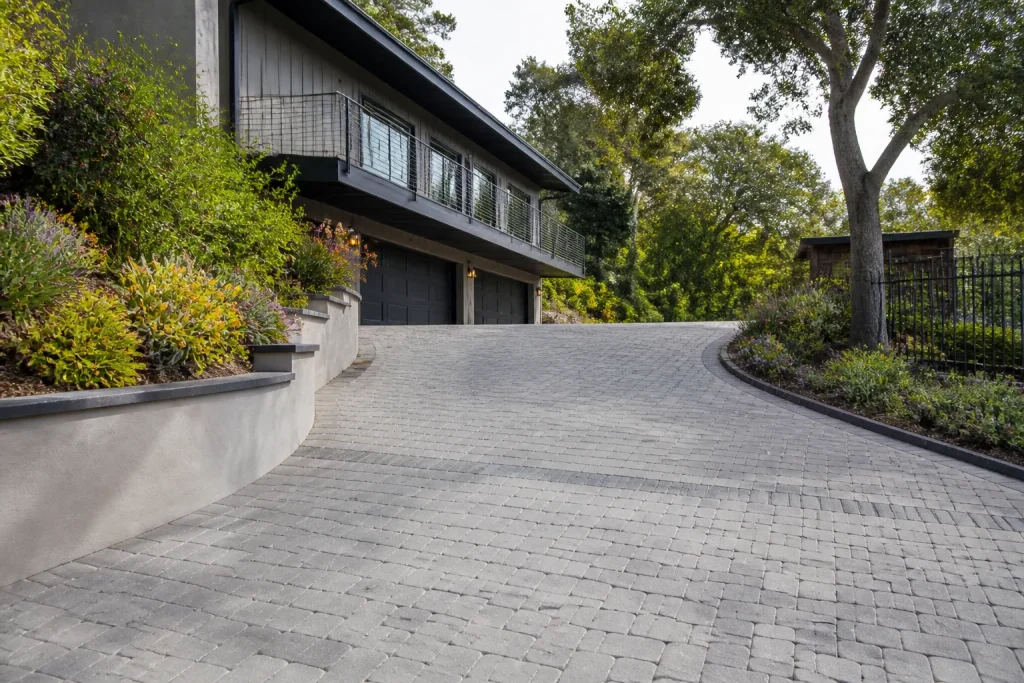
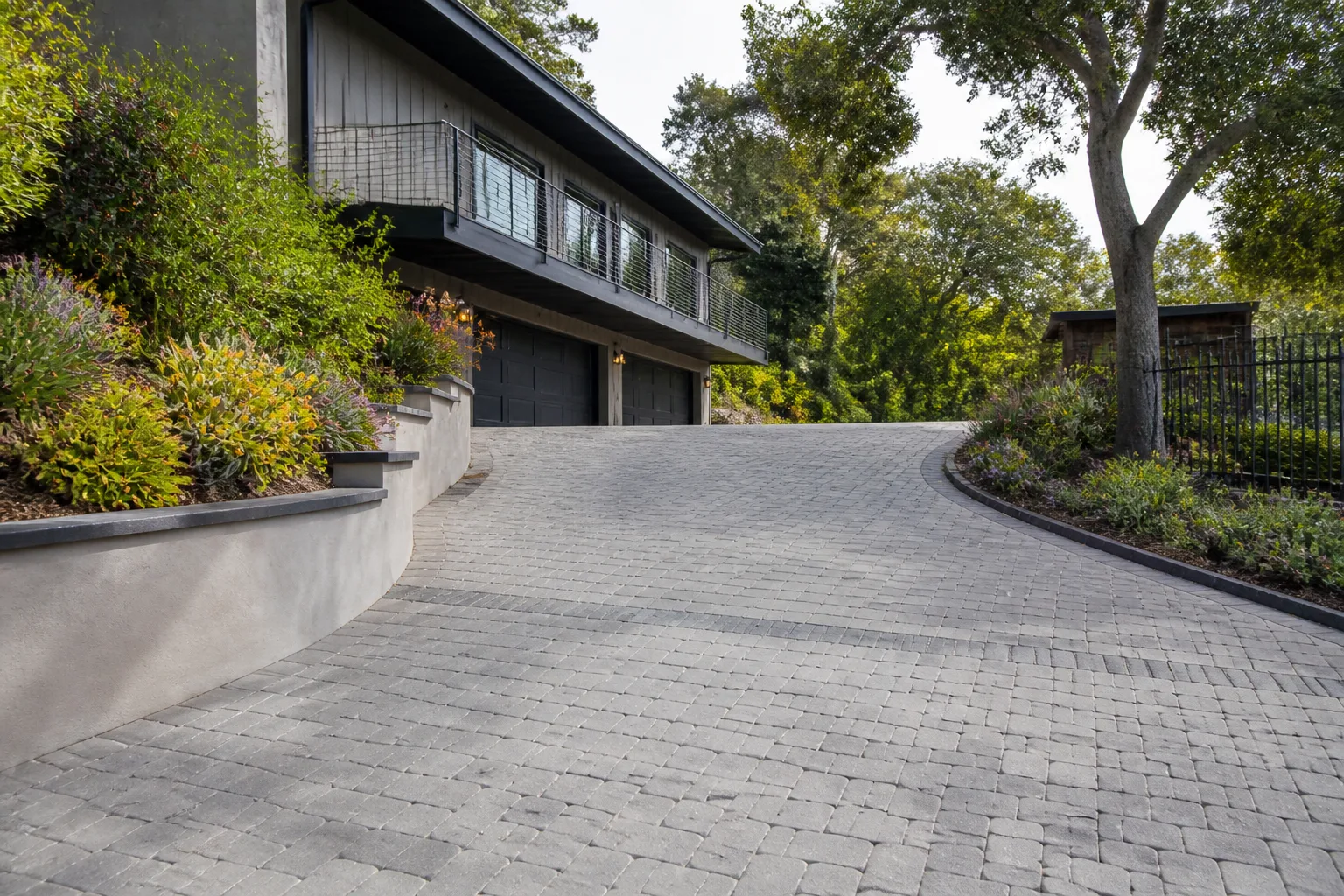
Wellborn Driveway & Pavers in Berkeley: A Homeowner’s Guide
A paver that looks great on day one and fails at year three isn’t a material problem – it’s a specification problem. Wellborn built its reputation by refusing to cut corners on material selection and construction standards. That same refusal is what separates a 20-year driveway from one that needs repair by the first drought cycle. This guide borrows that precision-first mindset and applies it to hardscape decisions in Berkeley, where wet winters, coastal fog, and dry summers stress a driveway in ways most sales brochures never mention.
If you’d rather not sort through compaction specs and porosity ratings on your own, call (855) 471-4163. We’ll walk you through what actually matters for your Berkeley property.
What Does ‘Construction-Grade’ Actually Mean for Pavers in Berkeley?
Construction-grade pavers are manufactured to meet a defined compressive strength and dimensional tolerance, tested to standards like ASTM C936 for concrete or C1272 for brick. Builder-grade pavers are made to hit a price point, often with looser thickness tolerances and higher absorption rates. The difference shows up years later, not on the pallet.
Here’s how to tell which category you’re being sold before you sign anything:
- Ask for the spec sheet. A construction-grade paver comes with published compressive strength (typically 8,000 psi or higher for concrete), water absorption (under 5% for freeze-thaw climates), and dimensional tolerance. If the supplier can’t hand you those numbers, you’re looking at builder-grade.
- Check thickness consistency. Construction-grade pavers hold thickness to within about 1/16 inch across a pallet. Builder-grade varies more, which means uneven bedding, rocking, and joints that open up during Berkeley’s wet season.
- Look at the color lot. A single-pallet order from a reputable manufacturer has consistent color. If you see visible batch variation, that’s a sign of lower quality control.
- Confirm the joint sand spec. Construction-grade installs use polymeric sand rated for your climate zone. Builder-grade jobs often use plain sand that washes out after the first heavy rain.
In Berkeley, we regularly see driveways on Elmwood and North Berkeley lots where builder-grade pavers were installed over a thin base. Two wet seasons in, the pavers are rocking and the joints have turned into miniature drainage channels. The paver wasn’t the failure – the specification was.
Wood Stability and Paver Density: The Parallel That Matters
Wellborn controls moisture content in its cabinet wood to a narrow range because wood that’s too wet or too dry moves, warps, and cracks after installation. Paver installations face the same physics. A paver with high porosity absorbs water during Berkeley’s rainy season, expands slightly, then contracts in the dry summer sun. Repeat that cycle for a decade and you get surface spalling, cracked edges, and a driveway that looks 15 years old when it’s only five.
Density and porosity specs are the numbers that predict long-term performance in Berkeley’s climate. Here’s what to look for:
- Concrete pavers: Water absorption under 5%. Anything higher is a problem in a climate with 25-plus inches of annual rain and coastal fog.
- Brick pavers: Absorption under 8% for exterior hardscape. Higher-absorption brick will spall in Berkeley’s wet winters, especially on north-facing driveways that stay damp longer.
- Porcelain pavers: Absorption under 0.5%. These handle Berkeley’s wet-dry cycles better than almost anything else, but they require a rigid base and careful installation.
- Natural stone: Density varies widely. Granite and basalt are dense and stable. Sandstone and some limestones are porous and will need sealing in Berkeley’s climate.
We pulled a driveway out of a garage in the Thousand Oaks area last year where builder-grade concrete pavers had been laid over a 2-inch sand base with no compacted aggregate underneath. The pavers themselves were fine. The base was the problem. Density specs tell you what the material can handle; the base tells you whether it will actually get the chance.
Surface Finish, UV Resistance, and Berkeley’s Sun-and-Fog Cycle
Berkeley’s climate is unusual. You get coastal fog and moisture for months, then direct summer sun that can push surface temperatures on a dark paver to 140 degrees Fahrenheit or higher. That combination breaks down cheap surface finishes faster than either condition alone would.
Evaluating finish quality comes down to three things:
- Finish depth. Integral color goes all the way through the paver. Surface-applied color or thin coatings sit on top and wear away under foot traffic and UV exposure. Ask whether the color is integral or applied.
- UV stability rating. Construction-grade pavers use UV-stable pigments. Builder-grade pavers sometimes use iron oxide pigments that fade noticeably within three to five years in direct sun. On a west-facing Berkeley driveway that gets full afternoon sun, the difference is visible.
- Sealer compatibility. Some pavers are designed to be sealed; others perform better unsealed. Penetrating sealers work well on dense concrete and porcelain. Film-forming sealers can trap moisture on porous materials and cause spalling in Berkeley’s wet season. Match the sealer to the material, not the other way around.
We see faded, chalky driveways all over the Berkeley flats where a thin applied finish was sold as “premium color.” The fix is a full replacement, not a recoat. Getting the finish spec right upfront costs a fraction of that.
Why Color and Thickness Consistency Across a Pallet Matters Structurally
Color variation is an aesthetic issue. Thickness variation is a structural one. When pavers in the same pallet vary in thickness by 1/8 inch or more, the bedding sand compacts unevenly, and you get high and low spots that collect water. In Berkeley, where a driveway might see 60 or more rain events in a wet year, standing water in low spots accelerates joint sand loss and base erosion.
Consistency standards to ask about:
- Thickness tolerance: Construction-grade concrete pavers typically hold to within 1/16 inch. Ask for the manufacturer’s published tolerance.
- Color consistency: A reputable manufacturer blends color across the production run. A cheap pallet with obvious light and dark batches signals poor quality control.
- Edge chamfer: Consistent chamfer (the beveled edge) is a manufacturing quality indicator. Irregular chamfer means worn molds or loose tolerances.
- Compressive strength testing: Ask whether the manufacturer tests every batch or samples periodically. Batch testing is the construction-grade standard.
When you’re comparing bids, ask each contractor which manufacturer and product line they’re specifying, then look up the published tolerances yourself. A contractor who can answer that question without hesitation is usually specifying construction-grade material. One who says “it’s all about the same” isn’t.
The Honest 10-Year Maintenance Calendar for Berkeley Pavers
Maintenance requirements vary by material, and Berkeley’s climate adds specific demands. Here’s what to expect over the first decade:
- Concrete pavers: Re-sand joints every 2-3 years with polymeric sand. Clean annually with a stiff broom and mild detergent. Reapply penetrating sealer every 3-5 years if the surface starts absorbing water visibly. Expect one full joint re-sand around year 7-8.
- Brick pavers: Inspect for spalling after each wet season, especially on north-facing driveways. Re-sand joints every 2-3 years. Seal every 3-4 years with a breathable sealer. Replace individual spalled units as needed, typically a handful over 10 years in Berkeley’s climate.
- Porcelain pavers: Lowest maintenance of the group. Sweep regularly, wash with water and mild soap. Joints may need attention every 5-7 years. No sealing required. Watch for chips at edges from dropped objects.
- Natural stone: Varies by stone type. Granite needs joint re-sanding every 3-4 years and sealing every 5-7 years. Sandstone and limestone need annual sealing in Berkeley’s wet climate and more frequent joint maintenance. Expect at least one significant repair over 10 years.
Across all materials, keep drainage paths clear and address any rocking pavers immediately. A single rocking paver lets water into the base, and that’s where the real damage starts. In our experience, the driveways that last 20 years in Berkeley aren’t the ones with the most expensive pavers – they’re the ones where the homeowner caught small problems early.
When to Call a Pro
Some paver work is genuinely DIY-friendly: re-sanding joints, cleaning, applying sealer. But base preparation, excavation, compaction, and drainage grading require equipment and experience that most homeowners don’t have. A driveway that’s failing because of base problems can’t be fixed by re-sanding the joints – the base has to come up. That’s a pro job.
If you’re seeing rocking pavers, standing water after rain, or joints that won’t hold sand, the problem is almost certainly below the surface. Call (855) 471-4163 and we’ll take a look. Our technicians have up to 12 years of experience with Berkeley hardscape conditions, and every project is covered by our 730-Day Done Right Promise – if it’s not done right, we make it right.
Related services in Berkeley: Driveway & Pavers in Berkeley for full installation and repair, and Fence Installation in Berkeley if you’re planning to update your property’s perimeter at the same time.
The Bottom Line
Specification is everything. The pavers that last 20 years in Berkeley aren’t magic – they’re construction-grade material with published density and tolerance specs, installed over a properly compacted base by someone who understands how coastal moisture and summer sun interact with surface finish. Ask for the spec sheet. Check the thickness tolerance. Understand the maintenance calendar before you commit.
If you’re in Berkeley and need help sorting through paver options, Groundwork Construction Co. of Berkeley offers free estimates. Call (855) 471-4163 to schedule yours – we answer live, 24/7, and you’ll get upfront pricing with no surprises. We also offer 0% financing for 18 months and $1,000 off projects over $10,000. Learn more about our full scope at Groundwork Construction Co. of Berkeley home, and if your project grows beyond the driveway, our Home Additions & ADU in Berkeley team can help with the bigger picture.
Frequently Asked Questions
A paver driveway in Berkeley typically runs $12 to $25 per square foot installed, depending on material. Concrete pavers sit at the lower end, porcelain and natural stone at the upper end. A standard two-car driveway of about 400 square feet usually lands between $5,000 and $10,000. Call (855) 471-4163 for an exact quote – estimates are free.
Construction-grade pavers properly installed over a compacted base last 20 to 30 years in Berkeley. The variables are material density, base preparation, and maintenance. Builder-grade pavers in the same climate often show significant wear by year 10. The paver itself is rarely the failure point – the base usually is.
Berkeley requires a permit for driveway work that affects the public right-of-way, changes drainage, or alters curb cuts. Replacement in kind often doesn’t require a permit, but it’s worth confirming with the city before work begins. We pull permits when required and can walk you through what your specific project needs. Call (855) 471-4163 for guidance.
Sometimes, but it depends on the condition of the concrete and the height clearance. A paver over concrete adds 1.5 to 2.5 inches of height, which can affect garage thresholds and drainage. If the existing concrete is cracked or settling, it needs to come out first. We assess this during the free estimate – call (855) 471-4163 to schedule.
Written by the team at Groundwork Construction Co. of Berkeley.
Need Construction Help?
Call Groundwork Construction Co. of Berkeley - licensed & insured, here with fast after-hours help in Berkeley.
(855) 471-4163